Sunday, August 26, 2012

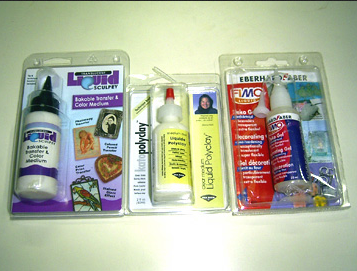
Liquid Polymer Clay Brands and Uses


Liquid clay is a useful and versatile addition to the world of polymer clay.  It works well as a primary medium when colored with oil-based paint, alcohol inks, or powdered pigments such as Pearl Ex powders.  When coloring liquid clay mix only a drop or two at a time until you reach the desired color.  It's easy to add too much color and ruin your results.

Batches of colored liquid clay can be stored in small plastic bottles.  You can create some really interesting effects if you use squeeze bottles with different sized tips.  Another way to store your colored liquid clay is to fill empty paint pot strips (like the kind you get with paint by number kits).  Empty paint pots strips are available in most craft stores.
Here are a few uses for liquid polymer clay:
*It can be used as an adhesive to bond layers or pieces of clay together.  This works with baked or unbaked clay.
*You can use it to make image transfers.
This image is linked to a tutorial for making butterfly wings using Translucent Liquid Sculpey

*You can add inclusions such as mica powders, glitter, or fibers to the liquid clay to create unique effects.


*You can use it to seal foils, leafing, and transfers.
*You can even use it to laminate paper.
One nice thing about liquid clay is that it's self leveling.  However, when using it as a sealer be sure not to apply it too thickly or you could end up with a cloudy finish.  You can sand or buff the liquid clay after baking to polish and add clarity to the finish.  You can make the surface more shiny by applying glaze to cured liquid clay.
Applying Liquid Clay
You can pour liquid clay directly from the bottle or use a toothpick, finger tip, or brush for detailed applications.  If using a brush, a high quality hair or synthetic brush works best.  Cheaper brushes may lose bristles in the liquid clay.  Any brush that's used to apply liquid clay must remain dedicated to that use since you won't be able to clean the liquid clay from the brush.  
To care for these brushes wipe the excess clay out of the bristles with a paper towel, stroking the towel in the direction of the bristles, away from the handle.  Cover the brushes with a small plastic bag  with the handle facing down when stored,  This keeps dust and debris out of the brush.  Liquid clay can be cleaned up with baby wipes or alcohol.
After a while the liquid clay in the brush may begin to thicken and firm up.  To recondition the brush work a few drops of liquid clay into the bristles to soften them.  Then drag the tip of a toothpick through the bristles to removes the excess clay.  Wipe the bristles with a paper towel and repeat as needed.  
You can also use a heat gun to sure liquid clay.  You can see when the clay has set: the sheen will disappear indicating that the clay has cured.
Brands of Liquid Clay

Fimo Liquid Decorating Gel comes in a 2 oz. bottle and is the clearest of the liquid clays.  It has the lowest viscosity and is very flexible after baking.  Thick layers will give you a satiny gloss finish and extremely thin layers give you a matte finish.

Kato Liquid Polyclay is available in 2 oz. and 8 oz. bottles and offers the second greatest clarity.  It has a medium thickness and cures with the most flexibility.  Whether used thick or thin it has a satiny gloss finish.

Translucent Liquid Sculpey comes in 2 oz. and 8 oz. bottles and is the thickest of the liquid clays.  It has the least amount of clarity when cured and can be thinned with Sculpey Diluent.  TLS cures hard and firm with a matte finish.

So now that you know a little more about liquid polymer clay I hope you'll do some experimenting and have fun with this versatile medium!


Saturday, August 25, 2012

Vote on the theme for our next Challenge!

The Smooshers haven't had a Challenge for a few months now, since I was dealing with a cross country move, but now that I'm settled in my new home it's Challenge time once again!  In order to participate in one of these Challenges you need to have an active shop on ArtFire, be a member of the Polymer Clay Smooshers guild, and create up to two entries based on the current theme.  The entries need to be handmade and must incorporate polymer clay and they need to be listed in your ArtFire shop.  Those guild members who participate in these Challenges will not only enjoy the fun and challenge of pushing their skills a little farther, but will also benefit from the additional promotion of their shops and entries.  Your entries will be promoted on the Smooshers blog, the Smooshers Facebook page, in the ArtFire forums, on Pinterest, Wanelo, and if I get enough entries (at least 16) I'll put together a Collection and a video.

The theme choices for this Challenge are Autumn Colors, Falling For You, Halloween, and Back To School.

Anyone can place a vote- you don't have to be a guild member to vote on the theme. You have until August 31st to place your vote.  For some reason I can't seem to add a poll to the blog, but you can leave a comment on this post with your choice for the theme.
Once a theme has been chosen you'll have a month to complete your entries and post a link in the Smooshers guild forums.  I'll send out a guild bulletin with the winning theme and the due date.  I encourage all guild members to vote and enter their creations in these Challenges.  Not only is it a lot of fun, but very often you end up learning new skills and improving your craftsmanship!  And everyone else gets to enjoy the amazing creations of the Polymer Clay Smooshers guild (all of which will be up for sale)!  Thanks for commenting and voting! :-)

Friday, August 24, 2012

Beautiful Blue collection from the Smooshers


Wednesday, August 22, 2012

A look at the different brands of polymer clay

Each brand of polymer clay has it's own benefits and limitations when it comes to workability, strength, flexibility, firmness, and working time.  Personal experience and what the clay is being used to create is the best determining factor when it comes to choosing a brand of clay.
If properly stored (out of  direct sunlight and away from heat sources), polymer clay has an indefinite shelf life.  You also want to avoid certain types of plastic when storing your clay.  Rigid plastic containers can leach the plasticizers from the clay making it brittle.  I store my opened clay in plastic sandwich  bags which I then put in another container.  I keep my colors in separate bags to keep them from accidentally mixing and to keep the clay clean.  One of the great things about polymer clay is the fact that it's relatively inexpensive and you don't need a lot of expensive tools to work with it.  This makes it a great medium for beginners and children and gives crafters a chance to experiment and find out if this is the right medium for them.
Now on to the different brands of clay.

CERNIT is a clay that is often used by dollmakers.  Cernit offers a range of flesh tone colors and the clay has a lifelike translucency after baking.  It's a very firm clay and can be somewhat difficult to condition, but once it's baked it's quite strong and flexible.  You can find more than 60 different colors of Cernit polymer clay

FIMO Classic, originally simply called FIMO, is the oldest and probably most recognized brand of polymer clay.  FIMO Classic is very popular among caners who appreciate the strength and resiliency of the clay.  Once baked it offers a good degree of flexibility too.  FIMO Classic is available in 24 colors and bakes with a matte finish.

FIMO Soft is one of the easiest clays to condition and also offer the least amount of blade drag when slicing.  It remains flexible and strong after baking and has one of the longest open times for working the clay.  It also offers superior shelf life for millefiori canes.  FIMO Soft is available in more than 50 colors and bakes with a matte finish.  

Kato Polyclay is a newer brand of clay and was created by the collaboration of polymer clay artist Donna Kato and Van Aken International, a manufacturer of modeling compounds. It can be very stiff and takes longer than other clays to condition, but it's very strong and flexible after balking.  While most brands of polymer clay are generally baked at 275°F, Kato polyclay can be cured up to 300°F  for 30 minutes per 1/4" (5 mm) of thickness.  It is available in 17 colors and bakes with a light sheen.

Pardo is the newest clay available and is easy to condition and very strong after baking. It came to the US from Germany and has only been on the market for a few years. It's made from beeswax and other natural ingredients.  It comes in reusable packaging and is available in over 70 colors.   

Premo Sculpey is a medium soft clay that bakes with excellent strength and flexibility.  It can be stickier than other clays, but it's very easy to condition.  It bakes with a slight sheen finish and can be found in more than 30 colors.  Premo is my personal favorite when it comes to sculpting and jewelry making. Premo has an "artist's palette" of colors, which are designed to mix together the same way that artist's paints mix. Premo holds fine detail and is perfect for caning, mokume gane, mica shift, jewelry, home décor and functional item, as well as sculptural pieces.

Sculpey III was one of the first clays to come in individual colors.  It's very soft and easy to condition and offers good open time.  It bakes with a matte finish but isn't flexible and can be brittle after baking.  Sculpey III is best suited  for projects with density and bulk and can be found in more than 40 colors.  This is a good clay to use for covering armatures, or as a base for other projects.

Studio Sculpey is softer than Premo and is easy to condition.  It feels lighter and less dense than other brands and it bakes with a matte finish.  It's available in more than 50 colors and has good strength and flexibility.
And that's a brief overview of some of the most popular bands of clay available in crafts stores and online.